View
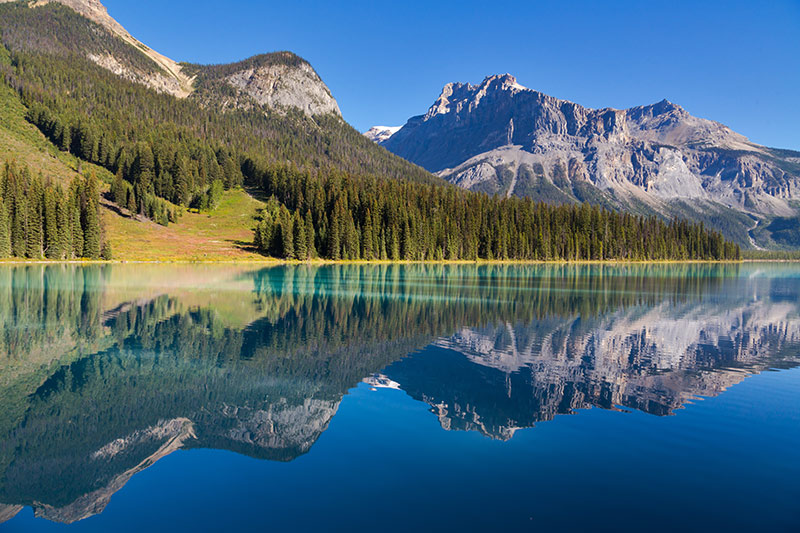
from Mount Norman, South Pender Island
|
Gulf Islands National
Park Reserve is one of Canada’s newest national parks. The park protects
a portion of British Columbia’s beautiful southern Gulf Islands -
a landscape of rocky headlands, forested hills and shorelines studded
with colourful tidepools. The park resembles a patchwork quilt of
protected lands scattered over 15 larger islands, and numerous islet,
reefs and approximately twenty-six square kilometres of marine areas.
The new national park reserve offers a variety of opportunities for
Canadians to learn about and experience an exceptional coastal island
landscape and the cultures of the people who live there. Be sure to
visit the Gulf Islands National Parks Reserve Operations Centre
in Sidney - it's certified as the most environmentally friendly in
the country. Ocean water provides the heat, low-flush toilets use
rainwater and even the temperature rises and falls depending on the
number of people inside.
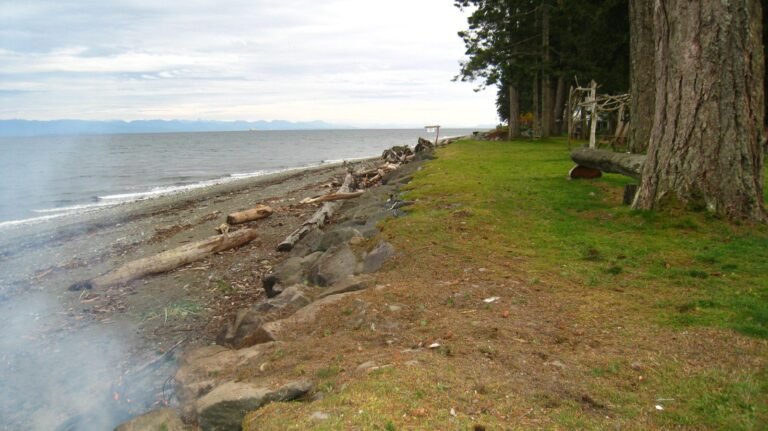
Coastline
at Beaumont/Mnt. Norman
|
Whether visiting
the larger populated islands or exploring the more remote areas of
the park, many local tour companies offer opportunities to explore
the islands - whether your interest lies in hiking, cycling, kayaking,
diving or whalewatching.
The park shares
the larger populated islands of Mayne, Saturna and the Penders with
vibrant island communities that offer a full range of tourist amenities.
Facilities and
services inside the national park are limited. Most campsites and
trails are located in the following former provincial parks now
included in the national park:
Other protected
areas in the Gulf Islands National Park Reserve are:
Benner Bay
The Bennett Bay component of Gulf Islands National Park Reserve
is located on the Strait of Georgia shore area of Mayne Island.
Its natural environment and undisturbed waterfront are combined
with one of the finest sand beaches in the Gulf Islands. The beautiful
peninsula (Campbell Point) features remnant old growth forest, a
walking trail and superb views from the point across to Georgeson
Island. Bennett Bay is a popular launch point for kayakers paddling
along the North Eastern shores of the outer Gulf Islands.
Blunden
Islet
Safeguarded by its inaccessibility, Blunden Islet off Teece Point
on South Pender Island is a relatively undisturbed islet, with typical
coastal bluff vegetation including arbutus, Garry oak and old growth
Douglas fir, and no evidence of invasion by exotic species. The
sensitive ecosystem on this islet is being afforded the highest
level of protection within the national park: authorized access
only.
Brackman
Island
Brackman Island had been an ecological reserve since 1989. The island
is unique in that it has never been affected by livestock grazing,
logging or settlement. There are pockets of old growth forest, some
as old as 250 years. Thirteen rare plant species have been identified.
This island is being afforded the highest level of protection within
the national park: authorized access only.
Channel Island
and nearby Islets
The Channel Islands in Captain Passage, located between Prevost
Island and Saltspring Island, are important as seal and sealion
haulouts and are also used for nesting by various bird species.
The Channel Islands were used by First Nations as landmarks when
navigating between islands, and for harvesting of marine mammals,
shellfish, barnacles, chitons and sea urchins. The Red Islets, Bright
Islet and Hawkins Islet located adjacent to Prevost Island feature
relatively undisturbed coastal bluff and Garry oak/arbutus woodland.
The sensitive ecosystems on these islands and islets are being afforded
the highest level of protection within the national park: authorized
access only.
Georgeson
Island
Located off Campbell Point at the southern end of Mayne Island,
Georgeson Island is a beautiful sandstone ridge, clad in old-growth
Douglas fir, arbutus and Garry oak forest. Because of sensitive
ecosystems, access is not permitted.
Georgina
Point
Georgina Point on Mayne Island sits at the entrance to Active Pass,
the marine passage between Mayne and Galiano Islands. This popular
day-use area, long managed by the Mayne Island Parks and Recreation
Commission, provides spectacular views across the Strait of Georgia.
It is one of Mayne Island’s most treasured heritage places.
Greenburn Lake
Freshwater lakes are rare in the Gulf Islands. Greenburn Lake and
its wetlands are vital to the recharge of South Pender Island’s
scarce water supply. The 118-hectare property also has high wildlife
values and contains pockets of endangered Garry oak ecosystem. Studies
are currently under way on the lake and wetlands. Visitors can hike
up along the old access road to this picturesque lake surrounded
by high bluffs. There are no visitor facilities at the lake. Bring
your own drinking water. Fishing is not permitted.
The Islets
Sprinkled throughout this area are a number of smaller islands and
islets. The ecosystems of these islands are fragile and easily impacted.
Some are important haulouts for marine mammals, others are key nesting
sites for seabirds, including species whose populations are threatened
or at risk. Visitors should exercise discretion when approaching
these islets, and abide by the wildlife viewing guidelines. The
islets in this area that are included in Gulf Islands National Park
Reserve are the Dock Islet, the Isabella Islets, Imrie Island, Grieg
Island and Reay Island, the Little Group, Sallas Rocks and Unit
Rocks. The sensitive ecosystems on these islands and islets are
being afforded the highest level of protection within the national
park. Special Preservation Area: authorized access only, except
for Little Samuel, an islet in the Belle Chain islets and Dock Inlet which is available for day-use along its shoreline
as a place for kayakers to take a break on longer paddling routes.
There are no services provided, however, and camping is prohibited.
Plan your paddling itinerary to include those islands in the area
where designated camping is allowed: D’Arcy, Portland Island, Rum
Island, Sidney Spit, and nearby Ruckle Provincial Park on Saltspring
Island.
James Bay and Selby Cove
James Bay and Selby Cove are located at the northern tip of Prevost
Island on Trincomali Channel, and are only accessible by water.
The park lands form a narrow point adjacent to a deep cove with
a shoreline that varies from steep rock faces on the Trincomali
Channel waterfront to gently rising, shelved rock near Peile Point,
to a gravel beach in James Bay. This open field campsite is popular
with kayakers, and there is good anchorage in Selby Cove.
Loretta’s Wood
The 38.7-hectare Loretta’s Wood property on North Pender Island
has high ecological values. Four provincially rare or endangered
plant communities, one vulnerable plant community, and the red-legged
frog - a COSEWIC-listed Species of Concern - occur here. The property
also contains wetland and terrestrial herbaceous ecosystems, both
of which have been identified in the joint federal-provincial Sensitive
Ecosystem Inventory initiative. Although no services and facilities
are currently provided, a trail system is under consideration for
the future.
Lyall Creek
A trail descends from the Narvaez Bay Road to the mouth of Lyall
Creek, passing through the forested heart of Saturna Island, and
featuring a beautiful waterfall. Lyall Creek is one of the few remaining
salmon-bearing streams in the Gulf Islands. When a small group of
volunteers began to restore a salmon stream on Saturna Island more
than 10 years ago, no one could predict the future of the private
land along the stream, or the success of the group’s conservation
efforts.
Pacific salmon
are remarkable for their ability to return to spawn in the streams
where they hatched. A washed out bridge and the culvert that replaced
it kept the chum salmon from returning to Lyall Creek. Chum salmon
- poor jumpers compared with the coho salmon and cutthroat trout
with which they share the stream - simply couldn’t make it to their
spawning grounds. The chum salmon might have never had a chance
to return without the efforts of Saturna Islanders. With support
from Fisheries and Oceans Canada, in the early 1990s they began
to incubate chum eggs in Lyall Creek and release the young salmon
into the ocean each spring. A decade later more than 400 salmon
were returning to the stream. The volunteers helped by moving the
adult salmon by hand across the still impassable culvert.
The inclusion
of the majority of the stream’s watershed within Gulf Islands National
Park Reserve brought additional technical and financial support
for the restoration. The culvert was replaced and a damaged part
of the streambed restored to a more natural state. More restoration
work is planned for the future.
Mount Warburton
Pike
The summit of Mount Warburton Pike on Saturna Island provides breath-taking
panoramic views of the southern Gulf Islands and the neighbouring
San Juan Islands in the United States. At 397 metres (1,303 ft.),
Warburton Pike is the second highest point of land in the Gulf Islands.
The open, grassy slopes of the ridge are unique in the Gulf Islands,
and the slopes and ridge itself are significant habitat for falcons
and eagles. First Nations used this mountaintop for spiritual and
sacred purposes. It was here spirit quest feathers (from eagles,
owls and falcons) were gathered and people came for spiritual ceremonies
and to camp. The road to the summit is unpaved, winding and narrow.
The summit area is currently being rehabilitated. All vehicles,
including bicycles must remain within the marked parking area.
Narvaez Bay
Narvaez Bay at the southern tip of Saturna Island is one of the
most beautiful and undisturbed bays in the southern Gulf Islands.
This area of regenerating Douglas fir forest and Garry oak-arbutus
ecosystems includes a prominent point that historically was the
first non-aboriginal settlement on Saturna Island. Park at the gate
at the end of Narvaez Bay Road, and walk past the gate and down
the road to the bay. Be careful walking out on the rocky promontory,
and stay well back from cliff edges: rocks may be slippery and the
drop-off is significant. Stay on the main path to avoid trampling
sensitive vegetation. Seven walk-in backcountry campsites are available
1.7 kilometres from the trailhead.
The Outer Islands
Fronting on the open waters of the Strait of Georgia, the Outer
Islands are the last bastion against the urban metropolis of mainland
British Columbia across the waters to the north. Facing the silhouettes
of skyscrapers by day, and the sparkling lights of a big city by
night, the Outer Islands are a serene contrast - so near to and
yet so far from the frenzy of modern life.
These islands
have always been important to those who travel the waters of the
inland Salish Sea. They were used by First Nations as a launching
area before they travelled into open water heading to the Fraser
River. Similarly, miners headed for the goldfields of British Columbia’s
interior made Mayne Island their last stop, giving rise to the name
Miners Bay.
The numerous
small islets paralleling Mayne and Saturna Islands support an abundance
of marine life and waterfowl. In days past, First Nations people
made stinging nettle nets to hang across narrow gaps between islets
to intercept migrating waterfowl. Codfish and their eggs were harvested
in shallow areas. The herring fishery has also played an important
role in the culture of First Nations. The method of fishing was
a ritual undertaken with grace and skill. Paddling a canoe, the
fisher would lower a rake which had pins of bones and in a gentle
swooping motion would prick the herring and catch it on the sharp
ends.
Saturna Island
was and still remains an important and special place for First Nations.
The island had affluent permanent village sites particularly on
the east and west shores of the inlets. People lived in large cedar
bighouses built using corner cedar posts. In some places, these
posts still stand.
Portlock
Point
Portlock Point/Richardson Bay surrounds the 1895 Portlock Point
lighthouse on three sides, protecting the most visible part of Prevost
Island seen by ferry passengers as they exit Active Pass on the
way to Victoria. The shoreline of Richardson Bay on Prevost Island
provides a good alternative to the nearby islets for a break for
kayakers on longer paddling routes. No Services.
Prevost
Island
Prevost
Harbour, Prevost Island, BC Gulf Islands
|
National park
reserve lands are located on both the north and south shores of
Prevost Island. The majority of the island, however, remains in
the hands of the descendants of Digby de Burgh—the man who bought
the island in the 1920s. They continue to farm and raise sheep on
the island. The island is largely unchanged from what would have
existed a century ago, and contains large cedar and arbutus groves.
Russell
Island
Settled by Hawaiians as early as 1886, this small island at
the mouth of Saltspring Island’s Fulford Harbour is blessed with
many of the natural features typical of the southern Gulf Islands.
Douglas fir, arbutus and Garry oak trees dominate the forest cover,
and stands of shore pine rim the island’s outer edges. Open meadows
of native grasses host yearly bursts of camas lilies and a variety
of other wildflowers. The original house dates back over a century.
The island has a small salt marsh. Marine access only. Facilities
include pit toilets and a loop trail, but no drinking water. The
historic Kanaka house can be found via a side trail that leaves
the northeast portion of the loop.
Taylor Point
This strip of virtually undisturbed old growth forest of Douglas
fir, arbutus and Garry oak on Saturna Island, running north from
Taylor Point to the vineyard, is one of the longest uninterrupted
stretches of protected shoreline in the southern Gulf Islands. The
cliffs are part of the rare coastal bluffs ecosystem in the Gulf
Islands. At Taylor Point, the remnants of a farm with its old stone
house and nearby sandstone quarry are reminders of one of the island’s
past commercial enterprises. There are currently no services at
Taylor Point. The adjacent lands are actively farmed and grazed.
Please respect private property and keep dogs on a leash to avoid
harm to livestock. Note that a trail has not yet been developed
to Taylor Point, although hikers occasionally flag their own routes
along the cliff edge. These are not designated trails, and being
close to the cliff edge, their routes may pose dangers to hikers.
Tumbo Island
Tumbo Island has recovered well from the fur farming, timber
harvesting and coal mining activities that highlighted its rich
and varied past. Today, the island, located off the southern tip
of Saturna Island, is largely forested with old growth Douglas fir
and Garry oak meadows. Tumbo Island derives its name from the landform
that gives it its distinctive shape - a tombolo. A tombolo is a
sandbar extending outward from shore connecting with an island -
or from island to island as it does here. First Nations found a
safe harbour on Tumbo Island when hand trolling for fish offshore
in their canoes or on their journeys across the Strait. The island
remains an important spiritual place to this day.
Tumbo Island can
be visited by kayak or by dinghy from larger boats. A short trail
system provides opportunities to explore the island. Discover the
diverse creatures who live in shoreline tidepools and the freshwater
marsh. Birding, photography and picnicking are other great activities
to pursue on Tumbo. Note that a life tenancy agreement for the house
on the island means that there may occasionally be someone in residence
on the island. Please respect their privacy.
Scenic Touring
The added bonus of scenic ferry rides makes car touring of Mayne
Island, Saturna Island and the Pender Islands a great way to experience
the Gulf Islands. Roads are narrow and winding - watch for cyclists
and pedestrians.
Boating
The Gulf Islands area is one of the most popular marine recreation
areas in Canada. Sailing, powerboating and kayaking are all great
ways to visit the national park reserve. Mooring buoys are located
at Sidney Spit (Sidney Island), Beaumont Marine Park (South Pender
Island) and Cabbage Island. Limited dock space is also available
at Sidney Spit, and dinghy docks are located at Tortoise Bay on
Portland Island during peak season, and at Royal Cove year round.
Only one boat is permitted per buoy and vessel size restrictions
are printed on the buoys. Fees for mooring buoys are collected from
May 15 to September 30 and the maximum total stay is 14 days per
calendar year.
There are numerous
marinas and boat charter companies in the area. Water taxis also
operate in several locations. Several excellent marina guidebooks
detail locations where potable water and holding tank pump-out facilities
are available. Holding tanks should be discharged at pump-out stations
and not in park waters.
Marine charts
produced by the Canadian Hydrographic Survey are available from
many marinas, marine supply stores and speciality bookshops. Check
the Canadian Hydrographic Service website for the location of a
chart dealer near you. The following charts cover portions of this
region: 3473, 3476, 3477, 3478, 3441, 3442, 3462, also refer to
their Sailing Directions (Pacific Coast).
Marine weather
and sea conditions can vary dramatically throughout the Gulf Islands.
Always check marine weather forecasts throughout the day to keep
abreast of conditions and check the tide table before beginning
your voyage.
Kayaking
Kayaking is a fun and challenging way to explore the Gulf Islands.
Whether kayaking with friends or a tour operator, be sure to check
the weather and tide tables in advance. Kayakers will need to bring
adequate water and pack out all their garbage.
Walking and
Hiking
Lace on your hiking boots and pack along some water if you plan
to tackle the up-and-down topography inland on the larger islands.
The terrain in the Gulf Islands is hilly and rocky, and there are
often steep cliffs dropping precipitously to the ocean. While this
is great terrain for goats, it isn't the best footing for visitors.
The challenge of hiking to a summit is rewarded with spectacular views
of the Gulf Islands, San Juan Islands and, on exceptionally clear
days, the snow-capped mountains of the BC Mainland and the Olympic
Peninsula in Washington state. Locally developed trails outside of
the national park reserve offer good hiking opportunities as well.
Beachcombing is also a favourite pass-time in the Gulf Islands.
Cycling
The narrow winding and hilly roads of Mayne Island, Saturna
Island and the Pender Islands attract many cyclists, providing challenging
but enjoyable cycling and offering a slower paced introduction to
the Gulf Islands.
There are no
bike lanes or paved shoulders, so cyclists must be particularly
vigilant when travelling these roads. There are no mountain biking
trails in Gulf Islands National Park Reserve and cycling on park
trails is not permitted. Bikes can be taken on the ferries, and
there are numerous bed and breakfasts and other accommodations available
to make "inn-to-inn" exploration a great way to experience the islands.
Camping
Drive-in campsites are available at Prior Centennial Park campground
on North Pender Island and McDonald Park campground located on Vancouver
Island, a short distance from the Swartz Bay ferry terminal. Campsites
that are easily accessible by boat or kayak are located on Cabbage,
Portland, D’Arcy, Rum, Sidney, and Prevost Islands, and Beaumont
Marine Park on South Pender Island. Beaumont can also be accessed
by hiking in from Ainslie Point Road. Camping is in designated areas
only, and is not permitted on park islets.
Picnicking
For a great place to picnic, try Winter Cove on Saturna Island,
Sidney Spit on Sidney Island, or Roesland on North Pender Island.
Fishing
Owing to the strength of the tidal currents coursing through Active
Pass between Mayne Island and Galiano Island, there are plenty of
nutrients in the water to attract marine life. Salmon feed in these
waters, although in recent years the large chinook have all but
disappeared. It's not as easy to purchase fresh seafood on the islands
as you might imagine. Most islanders do their own crabbing and shrimping,
but at Horton Bay on Mayne Island, you may find such delicacies
for sale. Although the availability is seasonal, stop by the federal
dock between 4 and 6pm and look for a truck with the personalized
licence plates CRAB 4U, which says it all.
For more information
on fishing in the waters of Active Pass around Mayne and Galiano
Islands there are two marine services in Miners Bay on Mayne Island;
and you can chat to the folks at the Corner Store, in Sturdies Bay
on Galiano Island. East Point Regional Park on Saturna Island is
a good place to spin-cast for salmon that feed in back eddies created
by the swirling currents. You can tell where the fish are biting
by looking to see where boats are congregating.
Gulf Islands
National Park Reserve is located in the Southern Gulf Islands of
British Columbia, between Vancouver Island and the mainland of BC.
The populated larger islands - Saturna Island, Mayne Island and
North and South Pender Islands - are accessible by vehicle, bicycle
and walk-on by BC Ferries from Victoria and Vancouver.
Gulf Island
Ferry Routes
|