|
The character
of a city is often defined by the vision of exceptional individuals.
One of the first park commissioners of Vancouver,
Matthew Logan, championed the idea of a pedestrian seawall that
would eventually ring the entire harbour, from Stanley Park to False
Creek. It took 55 years to complete, and today there is an almost
seamless route that covers much of the distance (about 12 miles/20
km), certainly more than most of us can traverse in the course of
a morning or afternoon's outing.
Each year the Stanley Park Seawall and the Seaside Bikeway
are thronged with an ever-larger number of walkers, joggers, in-line
skaters, and cyclists. Experiments in blending the various groups
have yielded the present system, which with its restrictions is
still less than satisfactory to all. Just take your time, exercise
caution, and wear a smile and you'll do fine. Some stretches are
busier than others. Unless you're an ardent people-watcher, see
if you can adjust the time of your visit to avoid the crowds that
predictably descend on the seawall on Sunday afternoons. Good starting
points for exploring the seawall on wheels include Brockton Point
in Stanley Park and First Avenue between
Cambie and Main Streets for the seaside bikeway. Parking is plentiful
at both locations. Bikes and blades can be rented from a number
of shops that border the park.
One of the
best places to begin exploring the paths in Pacific
Spirit Regional Park is at the park headquarters at 4915 W 16th
Avenue. You can pick up a free map here that will outline all the
trail options available to walkers, cyclists, and even in-line skaters.
You'll have to bring your off-road in-line skates with you, as most
of the park trails are unpaved, although many are compact enough
for skinny-tire cyclists to enjoy. A paved pathway does parallel
much of 16th Avenue as it passes through the park.
For a cycle
tour of Vancouver's docks, begin from the corner of Powell and Commissioner
Streets in east Vancouver where the Princeton Hotel, established
in the early 1900s, is one of the most prominent heritage establishments.
Cycle north from the Princeton on Commissioner Street, across the
Canada Pacific Railroad (CPR) tracks. Past the container terminal
- where cedar trees once stood so thickly, they concealed all view
of the ocean. Commissioner is a largely untravelled waterfront street,
with wide shoulders for cyclists to enjoy a long, lazy, rubber-necking,
thirst-building ride. A boulevard of grass between the street and
the rail line softens the environment on one side; a string of industrial
and marine-related companies line the harbour on Commissioner's
west side.
Follow it far enough - a 1.5-mile (3-km) ramble - and you reach
New Brighton Park. You'll find the entrance to it on Wall
St. Go east of Commissioner on Yale Street, then Wall Street, to
New Brighton Park, the site of Hastings Mill, the first European
settlement in Vancouver. Your reward for reaching the park will
be one of the best views of the Lions from anywhere in Burrard Inlet.
In summer, the park's open-air swimming pool is a big attraction
for eastside families.
Rocky Point
Park in Port Moody
is a place that will appeal to those with wheels to spin. The distance
from the Vancouver-Burnaby boundary to Port Moody is 9 miles (15
km), an easy 30-minute jaunt by car at off-peak times. Drive along
St. John's Street, Port Moody's main drag. Watch for signs that
point to Rocky Point Park. Turn north on Moody Street and follow
it to an overpass that leads to the park. A scenic, paved pathway
wraps itself around the east end of Burrard Inlet and runs for several
miles to Old Orchard Park. Paralleling it is a pedestrian-only walkway
through the park. Rocky Point Park also has a lengthy pier running
out into the shallow waters of Burrard Inlet's eastern end. There's
swimming here, both in the ocean and in a freshwater pool. A boardwalk
section of the walking trail passes over a marshy area of Burrard
Inlet around Rocky Point. In spring and fall this is an excellent
location for bird-watching.
The PoCo
Dike Trail ribbons the western shore of the Pitt River. Similar
to dike trails throughout the Fraser Estuary, the PoCo trail provides
a broad, level surface on which to cycle, with plenty of room for
all. The difference between the estuary and the Fraser Valley is
that the mountains are much closer to the towns of Port Coquitlam
(also called PoCo) and its neighbour, Coquitlam. Here at the northwestern
end of the Fraser Valley a feast of eye-catching peaks rises up
on both sides of the little prairie that the dikes protect from
seasonal floods. On the dike, the challenge is horizontal, not vertical.
On the PoCo Trail you can easily log 30 miles (50 km) round trip;
double that if you tie your ride in with the Alouette River dike
trails. (The Alouette is a tributary on the east side of the
Pitt River and has a series of dike trails of its own that leads
east from Pitt Meadows
towards Maple Ridge. Cross
the Pitt River Bridge to reach them from the PoCo Trail.)
Travel through
Port Coquitlam on Hwy 7. Turn north on Dominion Avenue or Coast
Meridian Road, just west of the Pitt River Bridge. (If you turn
at Coast Meridian, turn east onto Prairie Drive.) Go east on either
Dominion or Prairie until it reaches the dike, and park on the shoulder
where permitted. There's not much to see from the road, but as soon
as you climb up to the trail you get a panoramic view. Once you
get your wheels rolling, lift up your eyes and enjoy the scenery.
Motion in the Pitt River sets the pace: log booms line sections
of shoreline, while in places such as De Boville Slough, open areas
attract anglers. The PoCo trail heads inland for a short distance
in order to skirt the slough. North of here the trail becomes rougher
as it enters Coquitlam. The slopes of Mount Burke are suddenly much
closer at hand. The trail reaches its northern terminus at the foot
of Minnekhada Knoll. A wooden picnic gazebo welcomes visitors and
provides them with a view of Addington Point and the Pitt-Addington
Marsh Wildlife Management Area. A rough trail not well suited for
cycling curves out through this wildlife reserve and passes two
observation towers positioned beside the river. There's another
viewpoint from the summit of Minnekhada Knoll. A trail leads to
it from behind the kiosk, a steady 1-mile (1.6-km) hike.
Throughout the
1990s, the municipality of Langley
has been one of the leaders when it comes to developing trails for
cycling and in-line skating: the Langley Bike and Rollerblade
Trails. This means that in many places you'll find generous,
paved shoulders on both the backroads and some of the principal
routes that lead through this largely rural environment. Several
routes lead from Fort Langley
and Aldergrove Lake Regional Park.
The valley land
between the Fraser River and the Canada-US border ripples away like
the wake behind a troller. Early settlers didn't have an easy go
of it; the land was boggy and thick with mosquitoes in summer. But
having come this far, they dug in, cleared the trees, farmed the
land, and, in season, hunted and fished for wild game. You can still
get a scent of those years as you pedal the backroads along the
border of Surrey and Langley. Make Campbell
Valley Regional Park, off 200th Street in Langley, your hub.
Take Hwy 1 to the 200th Street exit and drive 9 miles (14.5 km)
south to either the 16th or Eighth Avenue entrances. Or, from Hwy
99, take the Eighth Avenue East exit and travel 4.7 miles (7.5 km)
to the South Valley entrance. (Note: Bicycles are not allowed on
park trails.)
Begin your ride
from either of the Campbell Valley Regional Park entrances on 16th
or Eighth Avenue, head to 200th Street, then south to Zero Avenue,
which runs along the Canada-US border. (Surprisingly, there aren't
any fences or signs forbidding crossings, just a dense scrub forest
and one lone concrete marker.) Cycle west on Zero Avenue to 184th
Street and then turn north. You are now on the Halls Prairie Road.
Immediately watch for one of the most gracious (and spacious) pioneer
farm homes on the east side as the road drops down into the Hazelmere
Valley. Perched on the hillside, the view from here of the North
Shore is captivating, particularly when the clouds part. From here,
head to Eighth Avenue and then east to return to Campbell Valley
Regional Park, for a total distance of 9 miles (14 km) round trip.
Other cycling
trails of interest include the 7-11 Trail (easy; 25 miles/40
km return) that follows the SkyTrain route between New
Westminster and Vancouver's Clark Drive. Vancouver's Riverfront
Park has a lengthy, paved cycle and in-line skate pathway beside
the mighty Fraser River. Throughout Vancouver,
cyclists enjoy 30 designated bicycle commuter routes on streets
such as Adanac, 37th Avenue, and Point Grey Road (all east-west),
and Ontario, Heather, and Cypress (all north-south). Cyclists and
in-line skaters also benefit from designated sections of sidewalk
when crossing the Burrard and Cambie Bridges.
Early European and Asian settlers in the Fraser River Estuary quickly
learned the importance of dike building to hold back both the ocean's
high tides and the river's annual floodwaters. Lulu Island,
the largest in the delta and home to the city of Richmond,
is embraced by all three arms of the Fraser. Seven bridges and the
George Massey Tunnel connect it to the rest of the Lower Mainland.
One of the first dike trails constructed in the Fraser Estuary was
on Lulu's south shore at London's Landing. Today, the island is
ringed by 48 miles (77 km) of dikes topped by easygoing walking
and cycling trails. As these trails are all level, you can cover
a lot of ground in an outing while soaking up the island scenery.
Begin your
jaunt at any one of numerous places along the dike. Two of the more
popular starting points are Terra Nova, at the northwestern
corner of the island, and Garry Point Park, on the southwestern
tip. The Terra Nova trailhead is located at the west end of River
Road. To get there, head west of Hwy 99 on Sea Island Way. Turn
south onto No. 3 Road and drive to the next major intersection,
Cambie Road. Turn west onto Cambie, which immediately blends into
River Road. Follow River Road west to its end, beside the Terra
Nova lands, and park there. An observation platform and picnic tables
are located nearby. At this point you can choose to head in several
directions. If you want to explore the open marsh, take the 3-mile
(5-km) West Dyke Trail. If you are more inclined to watch the action
on the Fraser River, try the Middle Arm Trail, which runs an equal
distance east along Moray Channel. All trails are well signed with
distances indicated in kilometres.
The West
Dyke Trail connects Terra Nova with Garry Point Park. A cycle
trip can just as easily begin from one point or the other. Garry
Point Park lies 3 miles (5 km) south of Terra Nova in the fishing
community of Steveston. The park entrance and trail are located
at the west end of Chatham Street. Take the Steveston Highway West
exit from Hwy 99 to reach Steveston.
The South
Arm Dyke Trail begins at the foot of No. 2 Road, just east of
the Steveston harbour, and runs 3 miles (5 km) to Woodward's Landing
Park beside the George Massey Tunnel and Hwy 99. Along the way,
you'll pass numerous interpretive signs that outline interesting
aspects of natural history, such as bird and fish migrations, as
well as heritage sites. This section of trail offers a variety of
stops for visitors to explore. You can pause for a look around at
London Farms, picnic on the pier at the foot of No. 2 Road, and
check out the old river homes on Finn Slough at the foot of No.
4 Road.
Sea Island's
backroads are a good place to cycle while watching planes or eagles,
osprey, and heron, take off and land. A good place to begin is Iona
Beach Regional Park. A causeway links Iona Island with Sea Island.
Plan on taking 45 minutes or so to pedal the lengthy 7.5-mile (12-km)
stretch of paved backroads that lead across Sea Island along Grauer,
McDonald, and Ferguson Roads. If the backroads don't completely
satisfy your will to wheel, tack on another 5.5 miles (9 km) by
riding out to the end of Iona's jetty and back. By then you'll be
saddle weary, for sure!
An impressive
stretch of dike trail runs beside Mud and Boundary Bays in Delta,
Richmond's neighbour to the south. The Boundary Bay Regional
Trail, which includes the East Delta Dike Trail, winds
around both bays, skirting the mudflats that once extended much
farther inland. Today's dike is a much sturdier version than the
crude ones built at the turn of the century. You can put in a full
day cycling 12 miles (20 km) one way between the Surrey-Delta border
and Boundary Bay Regional Park
in Tsawwassen. There are always shorebirds to entertain you, and
towards evening the sky around Mount Baker lights up in the southeast.
Access points to the dike trail include the entrance to Boundary
Bay Regional Park at the east end of 12th Avenue in Tsawwassen,
the south end of 64th or 72nd Street off Dewdney Trunk Road, and
the south end of 96th, 104th, or 112th Street off Hornby Drive near
Dewdney Trunk Road's intersection with Hwy 10.
Point Roberts
is located on the extreme southern tip of the peninsula that defines
Boundary Bay's western shoreline. Cyclists must cross the Canada-US
border on Point Roberts Road in Tsawwassen to enter or leave the
tiny enclave. Except for a steep hill south of Maple Beach, exploring
Point Roberts makes for a mostly level, 2-hour tour by bike. The
roads blend into one another in a simple rectangular grid and are
easy to follow. Whatcom County, Washington, of which Point Roberts
is a part, maintains Lighthouse Park, a delightful and often
overlooked park at the extreme southwestern point of the mainland.
From this windswept point, cyclists are rewarded with some of the
best views on the entire Fraser Estuary: Haro Strait and the Strait
of Juan de Fuca as well as the Strait of Georgia open up on three
sides.
There's even
more cycling to be had along the dike at Brunswick Point,
about 3 miles (5 km) west of Ladner
in Delta. To find the entrance to the dike, head west on Ladner
Trunk Road from downtown Ladner. Ladner Trunk Road soon becomes
River Road West. About 2 miles (3 km) west of Ladner, River Road
West passes the bridge over Canoe Passage, which links Delta with
Westham and Reifel Islands. The road continues past the bridge for
another 1.5 miles (2.5 km) as it winds its way to a gated cul-de-sac.
There is parking here, beside the dike. Mount up and pedal off.
A branch of
the South Arm of the Fraser River spreads out beside the dike. It
seems so relieved to have finally accomplished its long run to the
ocean that it emits a contented gurgle. As the river narrows between
Westham Island and Delta,
it forms Canoe Passage. From the parking area, the dike trail
leads west and then south as it curves around Brunswick Point. Canneries
once thrived here at the turn of the last century, as attested to
by the orderly rows of creosoted pilings that march like a doomed
army out towards Roberts Bank. Suddenly, the city seems very
remote. In the distance, a wall of Coast Mountains runs down the
Sunshine Coast, crosses the North Shore, and then heads towards
the Golden Ears, the distinctively shaped twin peaks of Mount Blanshard
in the north Fraser Valley. The Strait of Georgia expands west to
Vancouver Island. This scene is painted with broad brush strokes
indeed. One of the joys of such an easygoing trail is that you can
ride with your head up. You can do as much rubbernecking as you
please without worrying about a mishap.
It will take
you 30 minutes to ride the 4.5 miles (7 km) from the Brunswick Point
trailhead to the beginning of the Roberts Banks coal port causeway,
which juts out onto the bank. Freighters load coal brought here
in railcars from southeastern British Columbia. You can ride out
on the lengthy causeway for a look back at Brunswick Point and add
another 4.5 miles (7 km) to your journey. The Tsawwassen Indian
Reserve begins just south of the causeway. If the gate is open,
you can extend your ride to the BC Ferries Tsawwassen terminal
causeway, about 2 miles (6 km) farther south, in Tsawwassen.
By now you will be several hours from where you began. Along the
way you will pass viewpoints and places where you can park your
bike and rest atop a driftwood log. There's always plenty of wildlife
along the shoreline, where herons stand on guard while rafts of
waterfowl drift offshore.
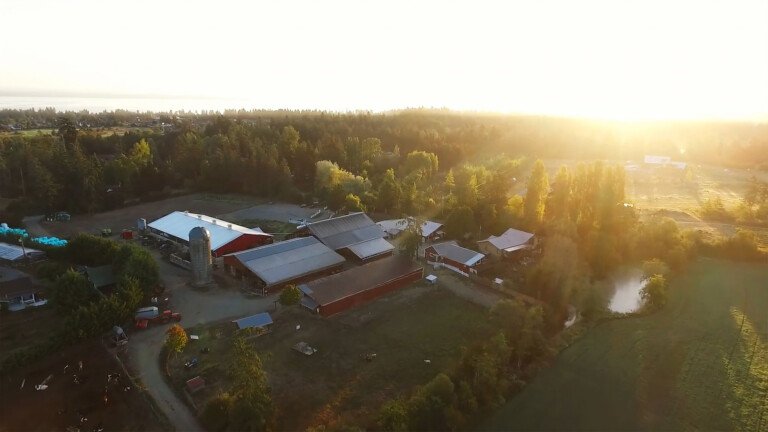
Barnston
Island in Surrey has
the flavour of both the Fraser Estuary and the Fraser Valley rolled
into one. A protective dike rings the diminutive island, which has
a distinctly agricultural air (and aroma). Dairy farming is the
main focus these days, as the soil is infested with iron worms,
a nasty little predator that attacks root crops. A park was created
at Robert Point on the northwestern tip of the island. A small barge
operates between the Surrey mainland and Barnston Island, which
lies east of Surrey Bend, and just beyond sight of the Port Mann
Bridge. There is no charge to use the ferry, which takes
less than 5 minutes to cross Parsons Channel. To reach the ferry
dock, take the 104th Avenue exit off Hwy 1 and follow it east until
it ends. Take 176th Street if you're approaching from the east.
It meets 104th at the ferry dock. The free ferry runs on demand
from 6:20am every day until midnight.
Although much
of Barnston Island is private property, there are access points
to the river, particularly at Robert and Mann Points. From the north
side of the island, the view is out over the Fraser River across
log booms and open water to the far shore, where light planes buzz
around the Pitt Meadows Airport. In the distance some familiar landmarks
loom, such as the knolls in the Pitt River Valley and the Golden
Ears to the northeast. For most of the time you spend cycling on
Barnston, your attention will probably turn away from the river
and towards the mighty contented cows, pigs, spring lambs, and ponies
in nearby fields.
The best view of the island is from the ferry landing as you arrive.
Look east past the farmhouses across the fields. In the distance
is Mann Point, the site of an old orchard where you can sit with
your legs hanging over the high bank and watch families of Canada
geese. In springtime, goslings are strung out in a row behind their
parents on the water, with their legs pumping against the current
to keep up. There are no tricks to this 6-mile (10-km) loop road
that rings the island. The choice of directions is simply left or
right from the ferry dock. If you head right and wish to reach the
slippery shoreline south of Mann Point, watch for a trail that leads
down the embankment just before an especially well-kept farm. Walk
from here to the point for a look at the eagles, herons, and geese
that enjoy the protection of the Barnston shoreline. Facing the
island on the Surrey side is a typical Fraser River industrial scene,
presently the island itself has no commercial development. In addition
to the loop road around Barnston, a secondary road leads through
the farm fields at mid-island.
|